
100 kJ to Calories – Formula, Conversion & Easy Guide
looked at a food label and saw “100 kJ” and wondered what that means in calories, you’re on the right Website. This quick guide explains exactly how to convert kilojoules to calories and why it matters for your health.
Quick Answer
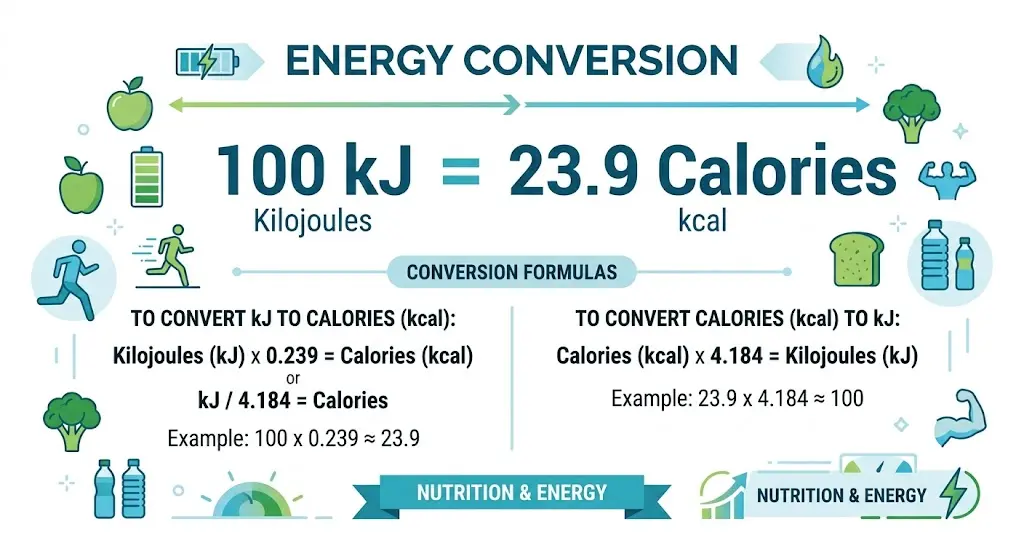
100 kJ = 23.9 Calories (kcal)
To convert any kilojoule value to calories, easily multiply by 0.239.
The Formula
Calories (kcal) = kJ × 0.239
So for 100 kJ: 100 × 0.239 = 23.9 kcal
Want to go the other way? To convert calories back to kJ, multiply by 4.184.
What Is a Kilojoule (kJ)?
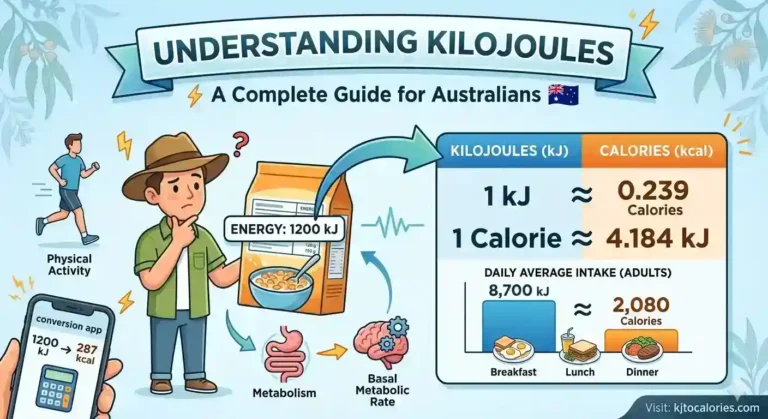
A kilojoule is a unit of energy in the metric system. One kilojoule equals 1,000 joules. Many countries — including Australia, New Zealand, and most of Europe — use kilojoules on food labels instead of calories. So if you’re reading a label from one of these countries, you’ll need to know how to convert.
What Is a Calorie (kcal)?
A calorie (kcal) is the unit of food energy most commonly used in the United States, Pakistan, India, and many other countries. When people say they “ate 2,000 calories today,” they mean kilocalories. One calorie equals 4.184 kilojoules.
kJ to Calories Conversion Table
| Kilojoules (kJ) | Calories (kcal) |
|---|---|
| 50 kJ | 11.95 kcal |
| 100 kJ | 23.90 kcal |
| 200 kJ | 47.80 kcal |
| 300 kJ | 71.70 kcal |
| 500 kJ | 119.50 kcal |
| 1000 kJ | 239.00 kcal |
| 2000 kJ | 478.00 kcal |
| 8700 kJ | 2079 kcal |
How Much Food Is 100 kJ?
To put 100 kJ (23.9 kcal) into real-life perspective, it is roughly the energy in:
- 1 plain rice cracker
- 2–3 small grapes
- A teaspoon of sugar
It’s a very small amount of food energy — less than 2% of the average adult’s daily requirement.
Daily Kilojoule Needs
The average adult needs about 8,700 kJ per day, which equals approximately 2,079 kcal. This varies based on age, gender, weight, and activity level. Athletes and active individuals may need significantly more.
Why Do Some Countries Use kJ?
Countries that follow the International System of Units (SI) officially use joules and kilojoules to measure energy. That’s why food packaging in Australia, New Zealand, and EU countries lists energy in kJ. The United States still uses kilocalories (kcal) as the standard on nutrition labels.
Frequently Asked Questions
Is 100 kJ the same as 100 calories?
No. 100 kJ equals only 23.9 calories. They are completely different units of measurement.
How do I convert kJ to calories without a calculator?
A quick mental trick: divide the kJ value by 4. It won’t be perfectly accurate, but it gives you a close estimate. For example, 100 ÷ 4 = 25 kcal (actual answer is 23.9).
Which is bigger — 1 kJ or 1 calorie?
One calorie (kcal) is bigger—1 kcal = 4.184 kJ.
One Comment